
What Is AI Infrastructure?
Artificial intelligence relies on more than the applications people interact with every day. Behind every AI chatbot, autonomous vehicle, recommendation engine, or intelligent assistant is a foundation of technologies that enable AI systems to process data, train models, and deliver results at scale.
This foundation is known as AI infrastructure. It includes the compute, data, connectivity, and power systems that make artificial intelligence possible. While AI applications are the visible products and services, AI infrastructure provides the underlying capabilities that support their development and operation.
As AI adoption continues to expand across industries, investment is increasingly extending beyond applications to the technologies that power the broader AI ecosystem.
The Four Layers of the AI Infrastructure Tech Stack
Artificial intelligence is supported by a layered ecosystem of technologies that work together to enable the development, deployment, and scaling of AI. While AI applications are the visible end products, the underlying infrastructure provides the capabilities that make those applications possible.
The AI Infrastructure Stack can be viewed as four foundational building blocks—each playing a distinct role in enabling the next generation of artificial intelligence.
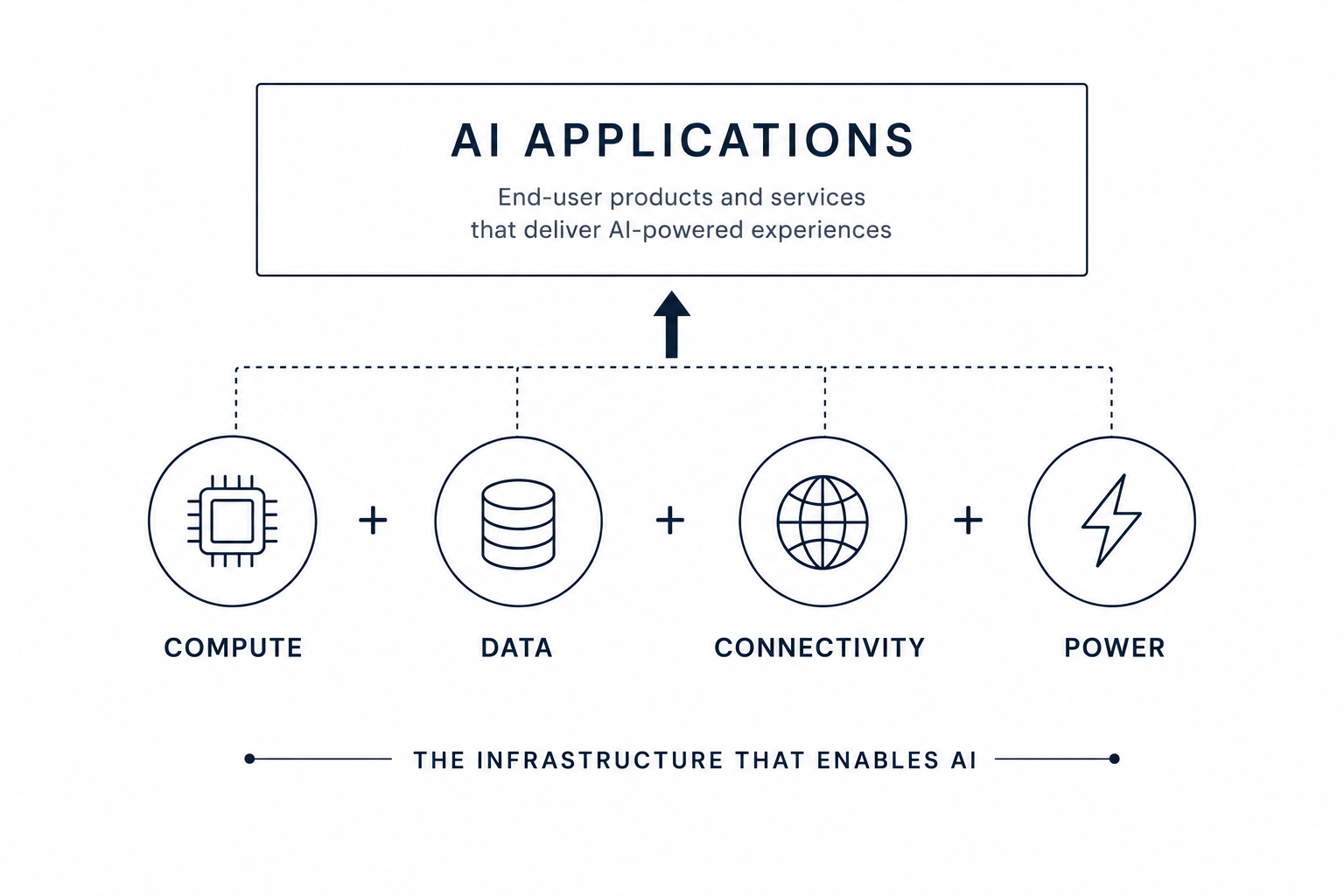
Together, these technologies form the foundation that enables modern AI systems to operate at scale.
The Four Layers of the AI Infrastructure Stack
| Infrastructure Layer | Core Function | Primary Demand Driver | Representative Private Leaders |
|---|---|---|---|
| Data & Analytics | Collects, cleans, and structures proprietary datasets for model training and real-time processing. | Unstructured enterprise data scale | Databricks |
| Specialized Compute | Delivers massive processing power required for model training and complex inference workloads. | GPU supply constraints & computing costs | Cerebras |
| Connectivity | Enables high-speed, ultra-low latency data transfer between chips, servers, and cloud environments. | Interconnect bandwidth bottlenecks | Ayar Labs |
| Power & Energy | Provides reliable, high-density power delivery and advanced cooling systems for AI data centers. | Grid capacity limits & thermal loads | Crusoe |
Market Growth & Capital Demand Behind AI Infrastructure
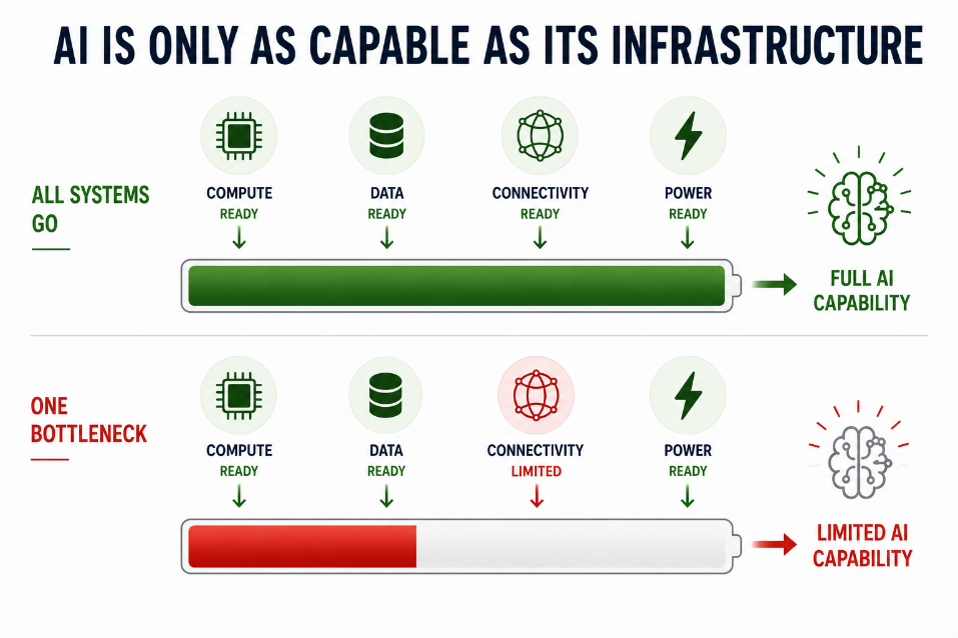
Artificial intelligence is transforming industries, but AI applications cannot scale without the infrastructure that powers them. As models become larger, more capable, and more widely deployed, the demands placed on underlying infrastructure continue to grow.
This growing demand is driving significant investment across the AI ecosystem. Companies are not only expanding AI infrastructure to meet growing demand but also advancing the technologies that will enable the next generation of AI capabilities.
Key Market Projections Driving AI Infrastructure Demand
| Market Focus | Projected Value | Timeframe | Benchmark Source |
|---|---|---|---|
| Hyperscaler AI Capital Expenditure | ~$700 Billion | By 2026 | Bloomberg / Industry Analyses |
| Global Data Center Electricity Demand | 565 TWh | By 2026 | Gartner Research |
| AI Inference Market Size | ~$292 Billion | By 2029 | Industry Consensus Projections |
| AI Inference Spending Growth | ~45% CAGR | Through 2029 | Market Forecasts |
As AI adoption accelerates, the technologies enabling its development and deployment are becoming increasingly important. While AI applications may capture the headlines, AI infrastructure provides the foundation that makes them possible.
Why Private Markets May Hold the Future of AI Infrastructure Advancement
The rapid growth of artificial intelligence is creating demand for the infrastructure that powers it, but many of the companies developing these foundational technologies remain privately held. As companies stay private longer, a greater share of innovation and value creation often occurs before an initial public offering.
For financial advisors and investors, this shift has highlighted the importance of looking beyond public markets when evaluating long-term AI investment opportunities. Private markets may provide access to companies advancing and expanding the technologies that enable the next generation of artificial intelligence.
The AI infrastructure ecosystem spans enterprise data platforms, specialized compute, optical connectivity, power infrastructure, and other foundational technologies. The Private Shares Fund has invested in companies representing several layers of this ecosystem, including Databricks, Ayar Labs, Crusoe and Cerebras.
Explore representative portfolio companiesFAQs
What is AI infrastructure?
AI infrastructure refers to the foundational technologies that enable artificial intelligence systems to operate. This includes specialized compute, data and analytics platforms, connectivity technologies, and the power infrastructure required to train, deploy, and scale AI models.
Why is AI infrastructure important?
As artificial intelligence becomes more capable and more widely adopted, demand for the technologies that support it continues to grow. AI infrastructure provides the foundation that enables AI applications to process data, perform complex computations, and operate at scale.
What are the main components of the AI infrastructure stack?
The AI infrastructure stack can be viewed across four core areas:
- Data & Analytics
- Specialized Compute
- Connectivity
- Power & Energy
Together, these technologies provide the foundation that supports modern AI applications.
What is AI inference?
AI inference is the process of using a trained AI model to generate predictions, recommendations, or responses from new data. As AI applications become more widely adopted, inference workloads are expected to grow significantly, increasing demand for the infrastructure required to support them.
What are AI infrastructure companies?
AI infrastructure companies develop the foundational technologies that enable artificial intelligence, including enterprise data platforms, specialized compute, connectivity, and power infrastructure. Examples include Databricks, Ayar Labs, Crusoe and Cerebras.
Why are many AI infrastructure companies still private?
Many technology companies are remaining private longer than in previous market cycles. As a result, a significant portion of innovation and company growth may occur before an initial public offering (IPO), making private markets an increasingly important part of the technology investment landscape.
How can investors gain exposure to AI infrastructure?
Investors can gain exposure through both public and private markets. While public companies play an important role in the AI ecosystem, many companies advancing foundational AI infrastructure technologies remain privately held, making private market investments an area of interest for some investors.
What is The Private Shares Fund?
The Private Shares Fund is a 1940 Act interval fund designed to provide investors with access to a diversified portfolio of late-stage private companies across multiple innovation themes, including artificial intelligence infrastructure. It requires no accreditation or subscription, has low investment minimums, uses 1099 tax reporting, a daily nav and offers access via the tickers PRIVX, PIIVX or PRLVX.