

Why Defense Technology Is Becoming A Major Private Market Theme
Defense technology has evolved beyond early-stage experimentation into a rapidly scaling segment of the private market ecosystem. Venture funding accelerated significantly in recent years as governments and investors increased focus on modernization, industrial capacity, and next-generation national security infrastructure.
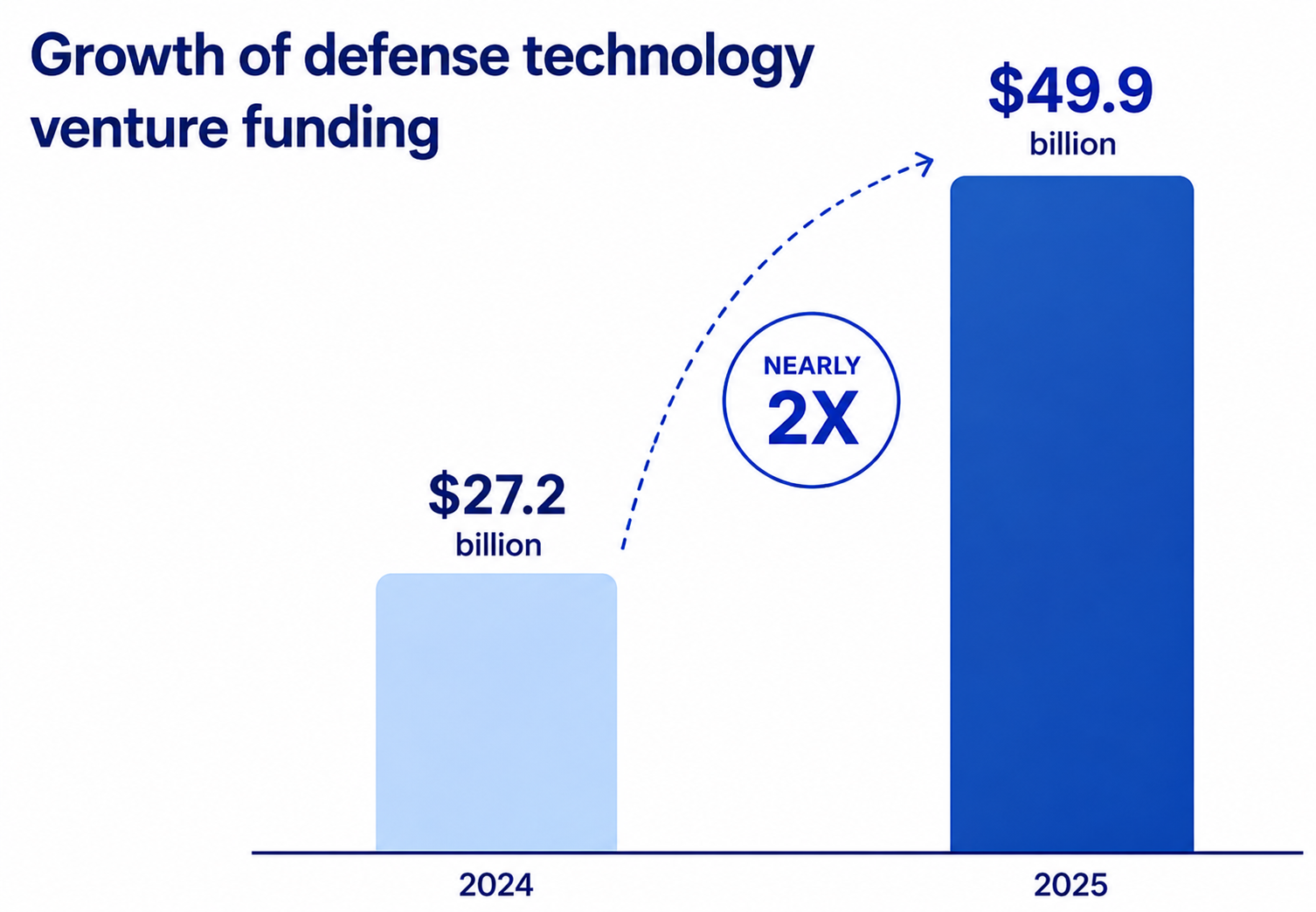
Funding Growth
Defense technology venture funding nearly doubled from 2024 to 2025.[1]
Late-Stage Concentration
Most capital flowed toward venture growth and late-stage companies focused on scaling production.[1]
Proposed FY2027 Budget
Recent federal budget proposals continue reinforcing modernization priorities across defense systems and infrastructure.[2,3]
The Institutional Shift: Accessing the Private Defense Ecosystem
The defense sector has moved beyond early-stage speculation into an established category of private equity defense exposure. With capital increasingly concentrated in venture growth and late-stage deals, the market is prioritizing late-stage private companies that have demonstrated proven manufacturing capacity.
This evolution highlights a structural gap in many traditional portfolios. While legacy defense primes are accessible via public markets, the specialized firms driving the prototype to production pivot are choosing to remain private for longer. Understanding how to access these high-barrier private assets is now a critical part of evaluating next-generation industrial growth as the sector shifts toward scaling critical national security infrastructure.
How Defense Technology Companies Are Scaling From Prototype To Production
The defense technology ecosystem is increasingly shifting from research and testing toward deployment and scaled production. Procurement pathways are evolving, manufacturing capacity is expanding, and private companies are playing a growing role in aerospace, autonomy, communications, and AI-enabled systems.
This shift is changing how investors and financial professionals evaluate innovation occurring within private markets.
Why Private Markets Are Playing A Growing Role In Defense Technology
Many companies shaping modern defense capabilities remain privately held for longer periods of time. Venture growth and late-stage private capital have enabled companies to continue scaling operations outside public markets while expanding manufacturing, infrastructure, and deployment capabilities.
As innovation increasingly develops within private ecosystems, investors are evaluating how private market exposure may complement broader portfolio discussions.
This is covered more in depth in the full white paper. Request your copy here.
Aerospace, AI, and Autonomy in Defense Technology
Modern defense innovation increasingly overlaps with broader commercial technology ecosystems.
- Aerospace & Space Infrastructure: Launch systems, satellite infrastructure, and communications networks continue shaping modern defense capabilities.
- Artificial Intelligence Infrastructure: AI systems and advanced computing are becoming increasingly integrated into defense and autonomy applications.
- Autonomous Systems: Autonomous vehicles, drones, robotics, and next-generation navigation systems continue attracting investment and procurement focus.
- Dual-use Innovation: Many technologies now operate across both commercial and defense applications, accelerating scalability and adoption.
The Growing Investment Focus on Defense Technology
As private companies continue scaling next-generation technologies, many investors and financial professionals are evaluating how innovation occurring within private markets may influence long-term portfolio positioning. This trend is occurring alongside broader shifts including:
- Companies remaining private longer
- Increasing late-stage capital formation
- Evolving procurement priorities
- Growing overlap between AI, aerospace, and defense infrastructure
FAQs
What is defense technology?
Defense technology refers to technologies and systems developed to support national security, military modernization, aerospace infrastructure, communications, autonomy, cybersecurity, and related capabilities. The category increasingly overlaps with commercial innovation areas such as artificial intelligence, robotics, satellite infrastructure, and advanced manufacturing.
What are dual-use technologies?
Dual-use technologies are technologies that can serve both commercial and defense-related applications. Examples may include satellite systems, AI infrastructure, autonomous systems, communications networks, robotics, and advanced computing platforms.
Why are many defense technology companies still private?
Many defense technology companies continue raising venture growth and late-stage private capital rather than entering public markets early in their lifecycle. Remaining private longer may allow companies to continue scaling operations, manufacturing capacity, and infrastructure while developing technologies over extended time horizons.
Why are private markets important in defense technology?
Many next-generation defense and aerospace technologies are being developed by privately held companies. As capital increasingly flows toward late-stage private companies, private markets are playing a growing role in funding innovation, deployment, and production scaling across the defense technology ecosystem.
How are aerospace and AI influencing defense innovation?
Aerospace systems, satellite infrastructure, autonomous platforms, and artificial intelligence are increasingly integrated into modern defense capabilities. Many emerging technologies now operate across both commercial and national security applications, accelerating development and adoption across multiple industries.
Why are investors paying attention to defense technology?
Investors and financial professionals are increasingly evaluating defense technology as governments prioritize modernization, procurement acceleration, industrial capacity, autonomy, AI infrastructure, and aerospace systems. Venture funding and late-stage private capital formation have also expanded significantly in recent years.
What is an interval fund?
An interval fund is a type of closed-end investment fund that periodically offers to repurchase a limited percentage of outstanding shares at net asset value (NAV). Unlike traditional mutual funds, interval funds are generally designed to invest in less liquid assets, including certain private market investments.
What is The Private Shares Fund?
The Private Shares Fund is a 1940 Act closed-end interval fund focused on late-stage private growth companies. The Fund invests across sectors including aerospace, AI infrastructure, autonomy, and defense technology. Read more about the Fund’s strategy here.


